
Product · September 15, 2026
New products. New research. Is your team ready?
 Romain Gagnon · September 15, 2026 · Founder & CEO
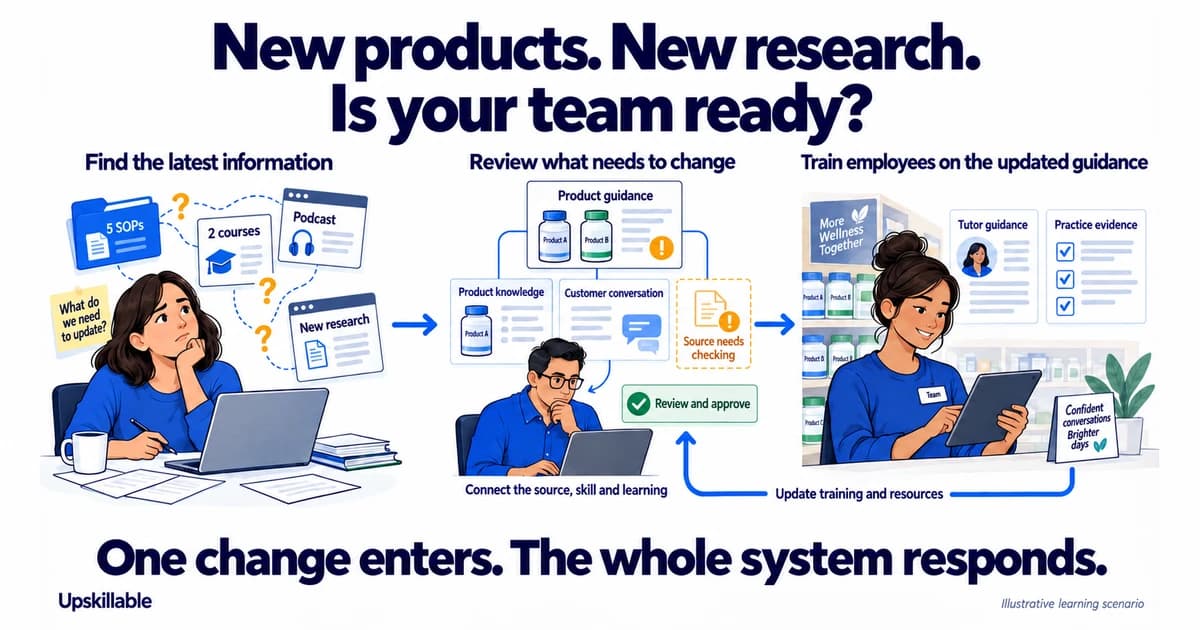
Three things changed this month. An expert review of new protein research changed your product guidance. Two new products joined next month’s launch. Operations revised the procedure for routing product questions to an expert.
Your training still describes the old range. The course employees open on the shop floor is the one you approved last month. Nobody has checked it against all three changes. Some of it can stay. Some needs updating. You don’t yet know where the line is.
You lead learning and development (L&D) for this chain of supplement stores. You have 5 standard operating procedures (SOPs), 2 courses, and a podcast to check before launch. Which parts do these changes affect, and what might employees still be learning from the old version?
Three changes. Four gaps.
Which content is still right?
- Scattered sources
Which SOPs still describe the old procedure? Does the podcast repeat it? Someone has to read and listen to find out.
- Exported courses
2 courses in the LMS. Their source documents aren’t attached, so you cannot trace the changed guidance to the lessons that use it.
- An assistant without the review
It can explain the old course fluently. Without the new guidance, its answer can carry forward the comparison you need to replace.
- The late report
Six weeks after launch, you learn where stores struggled. Customers who asked in week one may already have heard the old explanation.
The files still open. The courses still run. Your team has to work out where the changes matter.
The same uncertainty can follow a regulatory change in financial services while older compliance training is still assigned. An internal policy changes at the same time, and a new business goal raises another question: which learning already supports it? The changes overlap, but the content was built separately. Knowing one course needs an update does not tell you what else relies on the same guidance.
The Living Learning System
Upskillable connects the business goal, trusted knowledge, learning, guidance, and evidence. We call that approach the Living Learning System. For this launch, it starts with deciding what people need to do differently.
1. Find what the new information affects
The research review and the two new products both affect the product comparison. The routing change affects the SOP and any learning that teaches its steps. L&D works with product experts and store leaders to trace each change through the existing material and decide:
- Who needs an update? Identify the affected store teams.
- What must they demonstrate? Explain the new range and route questions correctly.
- What can stay? Keep the material that the change does not affect.
The team obtains and reviews the podcast transcript. It reveals an overlap: the podcast explains the old procedure using the old products. Updating the comparison alone would leave the routing advice out of date. L&D records what needs revision, who will review it, and what can stay. Generating a new course is only useful once the team has agreed what it needs to fix.
2. Build the learning for this launch
In Generate Studio, the creator uses the reviewed product guide and revised SOP to build a visual product comparison and a customer-conversation exercise. The review has narrowed the work to the affected explanations and practice. Material checked and found unaffected can stay. The product expert checks the explanation against the approved guidance. L&D checks whether the exercise asks employees to do the work they will face in store.
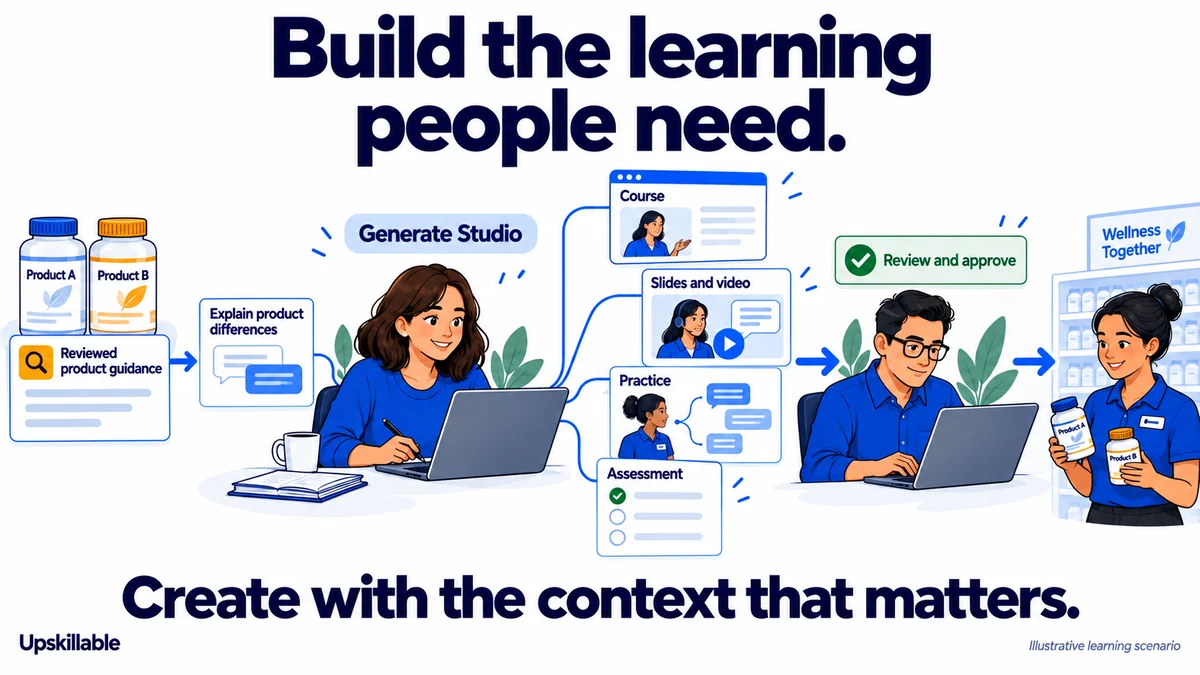
Operations approves the revised SOP. L&D includes its steps in practice and coordinates a podcast revision that covers both the comparison and the routing advice. Experienced employees focus on what changed. New starters get the fuller introduction. Each owner reviews their part before release.
The useful question at this handoff is simple: can the next person find the guidance behind the lesson and understand which version was approved?
3. Explain why the guidance changed
Engage puts the reviewed learning in front of the relevant store teams. On the shop floor, an employee picks up one of the new bottles. They know the old range well. They need the reason for the change, not another generic explanation of product comparisons.
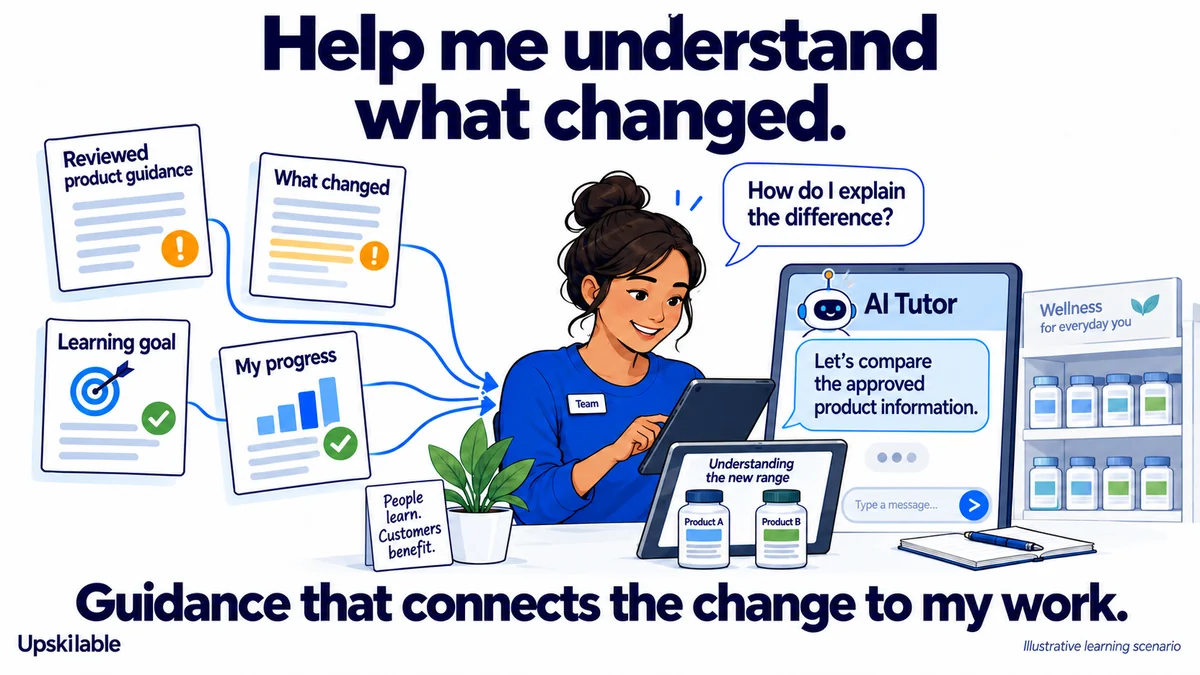
That answer depends on making the reviewed explanation available to the Tutor. If the source does not say why something changed, the Tutor cannot establish the reason from it. Questions the approved material cannot answer go to the appropriate expert.
A source name gives the employee something to check. The explanation can stay tied to what the expert approved instead of becoming another answer detached from its context.
4. Practice the customer conversation
The employee now practices answering a customer who points to two products and asks, “What’s the difference between these?”
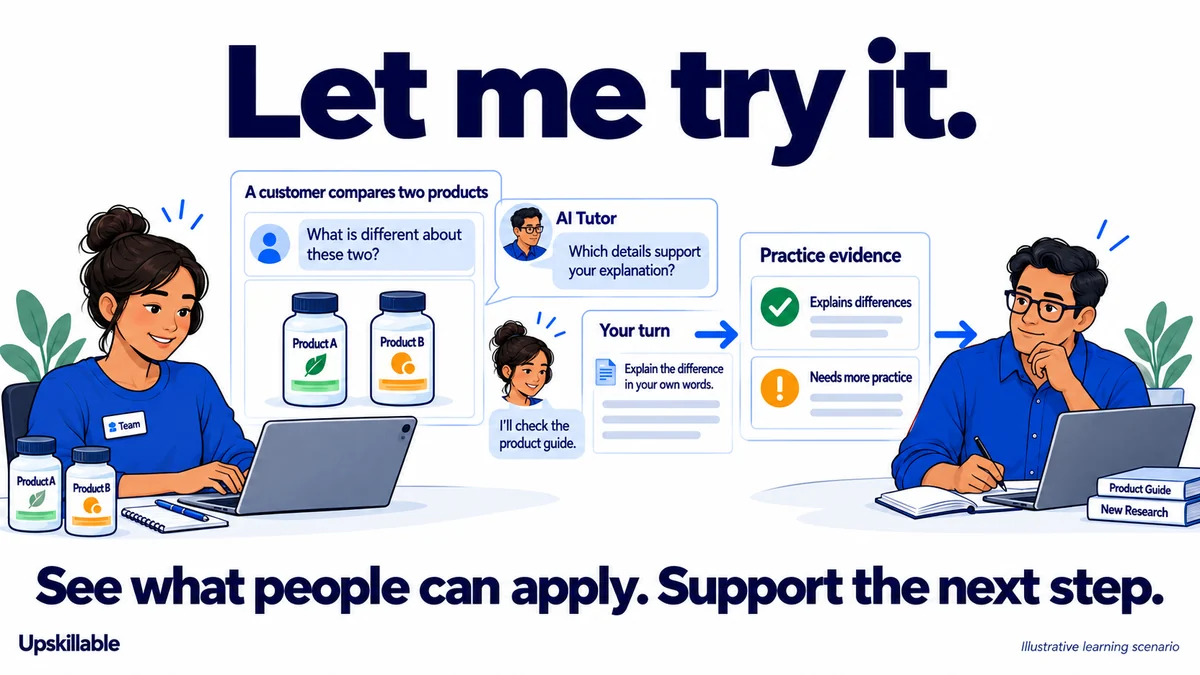
The AI Tutor asks which details support the explanation. The employee checks the product guide and tries again with feedback. A follow-up question goes beyond the guide, so they practice recording it and using the revised procedure to route it to an expert.
In Analyze, L&D and store managers review learning and assessment evidence to decide where to focus support. If several employees struggle with the same comparison, L&D takes that example back to the product expert. Managers decide who needs more practice before launch.
This brings the story back to the late report. Evidence earns its place when someone can act on it. After launch, managers still need to observe customer conversations. Completing a course or succeeding in practice does not by itself prove performance on the shop floor.
5. Prepare for the next launch
A few months later, another range is planned. L&D has kept the review record alongside the previous launch’s difficult questions and practice evidence. The team can see which material was revised, why it changed, and who reviewed it. That gives the next review a starting point.
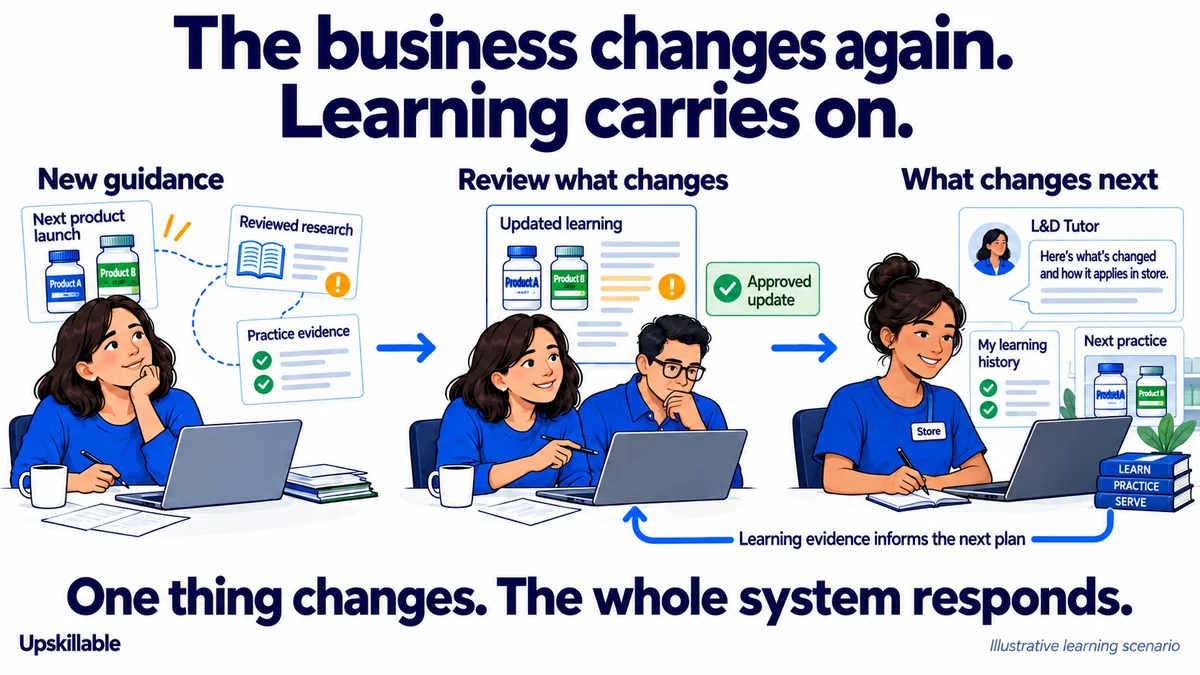
The aim is to carry those connections forward. New research still needs expert review. A revised procedure still needs an owner. Your team can spend the next planning conversation deciding what people need to learn, with the earlier decisions and evidence at hand.
One change enters. The whole system responds.
For the colleague holding the new product, that has a practical meaning: find the current explanation, understand why it changed, practice using it, and know when to ask an expert.
For L&D, the difference is knowing what the next update depends on. When research, products, and procedures change together, the aim is to review their impact without reconstructing the history of every course first.
Questions this story raises
What is a Living Learning System?
Upskillable’s Living Learning System connects the business goal, trusted knowledge, learning, guidance, and evidence so a change in the business can show up in what people learn and practice.
Why isn’t a generic AI assistant enough for this launch?
A generic answer can describe product comparisons. It cannot explain why your approved guidance changed unless that reviewed reason is available to it.
What is live today versus still in development?
Generate Studio, Engage, AI Tutor, and Analyze are live. Source-change detection and coordinated update review, as illustrated in this story, are development work. Teams still review and approve learning before release.
Does practice evidence prove shop-floor performance?
No. Analyze helps L&D and managers decide where to focus support. After launch, managers still need to observe customer conversations. Completing a course or succeeding in practice does not by itself prove performance on the shop floor.
That is the Living Learning System in practice. Business moves. Learning should too.
Next in this series: One change enters. The whole system responds. How a team decides which learning a launch needs, from the business goal to the evidence.
Bring us a change your employees need to learn. Let’s follow it from the source to the shop floor.
Illustrative scenario and artwork. Products, source titles, dialogue, and timing are examples, not medical guidance, study findings, or customer results.
Connect with us
Tell us what you are trying to get done.
This form reaches the Upskillable team. It is not a public comment thread. Prefer the longer path? Use Get started.
Prefer email? Reach us at hello@upskillable.ai.
Keep reading
Product
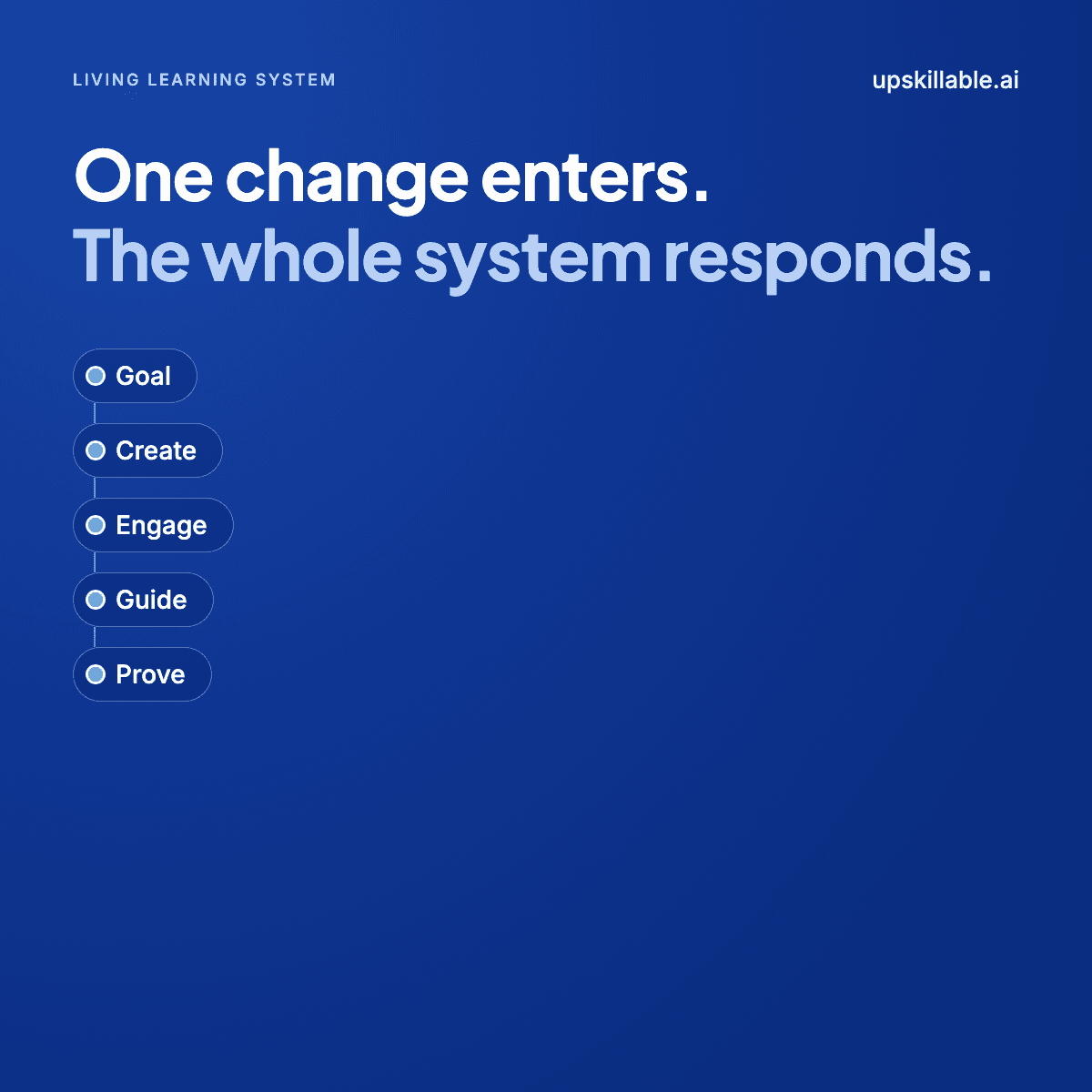
One change enters. The whole system responds.
Follow one business requirement through goals, skills, tasks, learning, guidance, and evidence. A practical look at connected enablement in Upskillable.
Romain Gagnon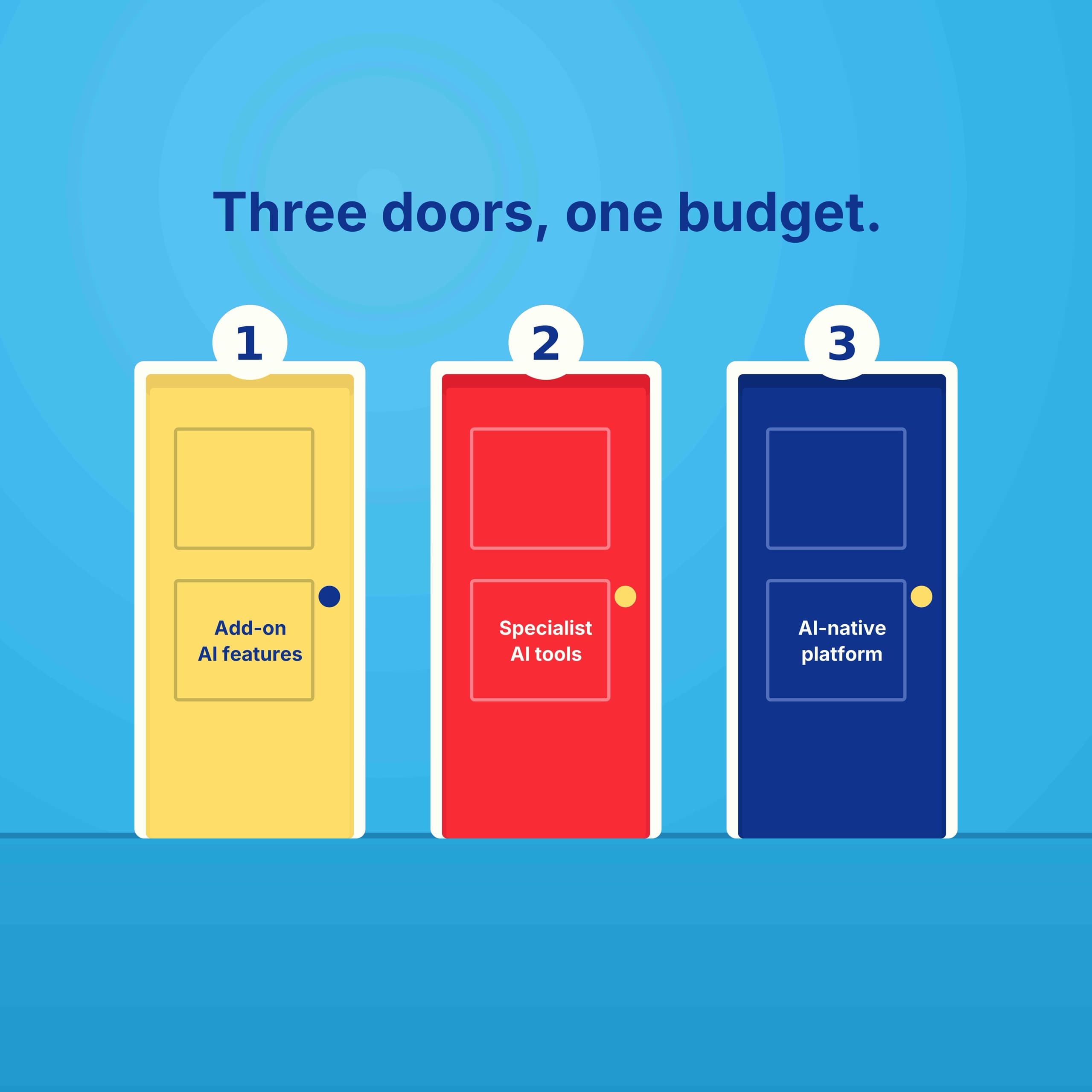
AI Authoring
Three doors to AI learning content authoring (and which one your team should walk through)
Three ways to buy AI authoring: LMS features you already pay for, a specialist point tool, or an AI-native platform. Real costs vendors do not headline, and a checklist for bolt-ons wearing the native label.
 Deborah Boccongelle · August 14, 2026