Instructional Design · August 14, 2026
AI Tutors and Online Courses: Why Learners Leave to Ask AI
 Romain Gagnon · August 14, 2026 · Founder & CEO
Introducing the Living Course
A model that keeps content, assessment, and capability connected.
I do this all the time.
I am in an online course. Nothing is wrong with it. Someone decided how much to explain, and they decided it once, months ago, for a learner who is not me.
The explanation does not land. Thirty seconds later, the course is open in one tab, ChatGPT or Google is in another, and there may be a book beside me.
Eventually I get it. But now I am holding two versions of the same idea, told in different words, and I have to decide which one is right for what I am actually doing. The course cannot help me with that. It does not know I left.
If you build courses, you have been on the other side of this. You chose the example, the level of detail, audience level, and how much guidance to provide. You chose once and you might also wind up creating multiple versions of the same course for different audiences.
That was not a bad design. It was good work inside a fixed format.
For learners, looking elsewhere is normal. We compare sources, ask questions, and build understanding from more than one explanation. The cost appears when the learner has to leave, rebuild the context, and reconnect everything alone.
Distribution was solved before continuous learning
SCORM solved an important problem. It gave the industry a common way to package, move, launch, and track learning content across compatible systems. That interoperability helped digital learning scale. The ADL guide still describes portability as one of its major benefits.
xAPI later expanded what organizations could record across online and offline learning experiences. It improved the data story. It did not turn a published course into an ongoing conversation with each returning learner.
That is not a criticism of either standard. They did the jobs they were built to do. The gap appears when the knowledge changes or you realize that there was missing information.
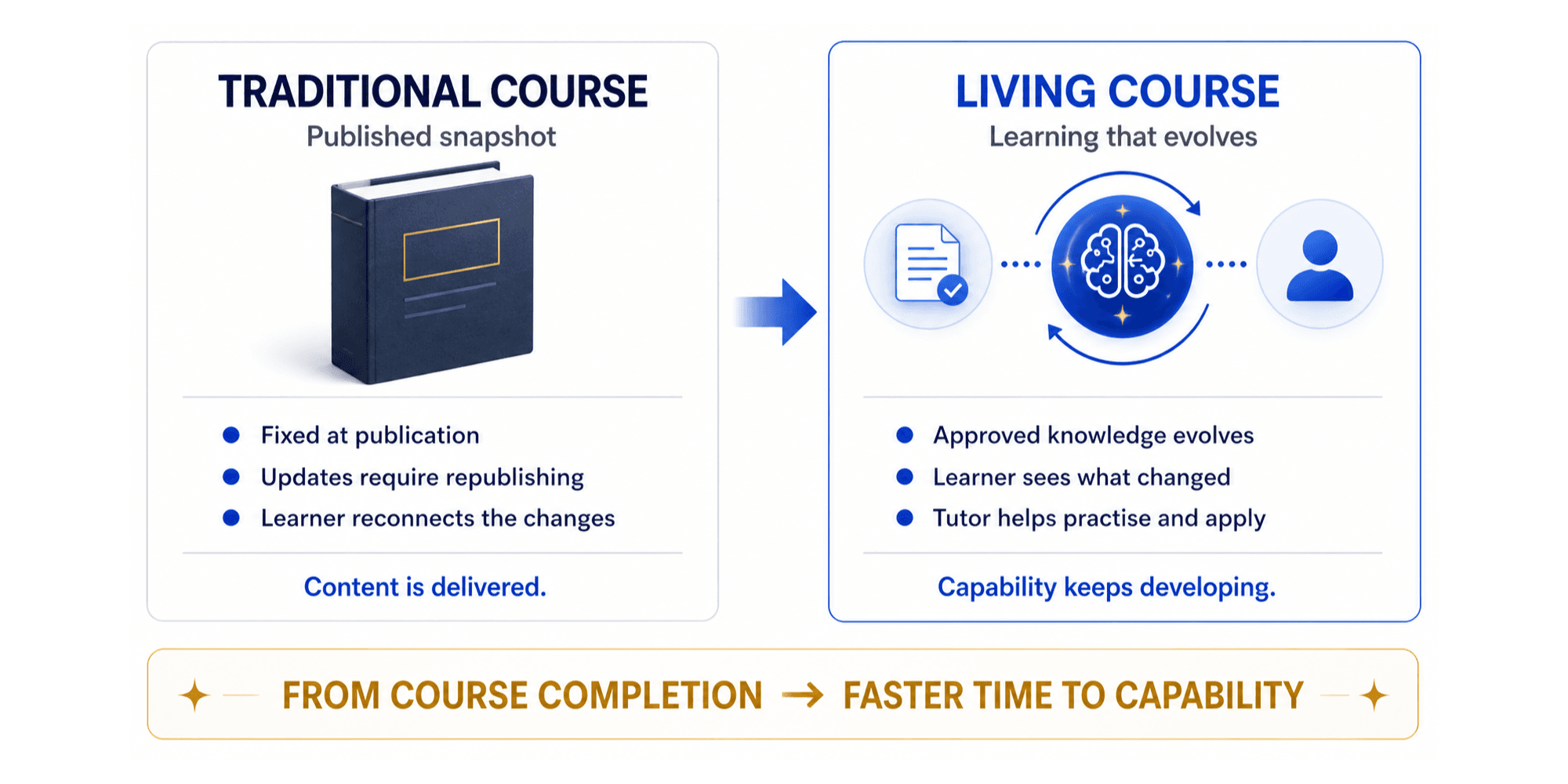
A packaged course captures a version of that knowledge at a particular moment. It can be edited and published again. What the new version does not automatically tell each learner is:
- What changed?
- Why did it change?
- Which parts of what I learned are still correct?
- What should I reconsider?
- Can I apply the change properly?
The issue is not neglect. A republished package does not, by itself, reconnect the update to what each person already learned.
The course gets updated. The learner does the stitching.
That becomes harder when products, regulations, internal processes, and AI practices change faster than traditional course cycles. A course can be correct when published and still become insufficient.
A Chatbot is not a Tutor
Now add AI. This is where it gets interesting, and a little uncomfortable.
Giving a learner a chatbot does not make it a Tutor.
A large field experiment followed nearly 1,000 high school mathematics students using 2 versions of GPT-4. One worked like a standard AI chatbot. The other was designed as a trained AI “Tutor” with guardrails informed by teachers and encouraged students to work through problems.
Both groups performed better while AI was available. The real test came later, when students had to work without it.
In the fast changing world of AI, studies done with older models should always be revisited as model improvements such as Claude Fable, GPT 5.6 would probably provide different outcomes. As a daily power AI user, I have to learn new skills or upskill myself almost on a monthly basis as newer techniques are discovered and model advancements.
That result should make anyone building an AI learning product pause. An answer can look like progress. Sometimes it is only borrowed performance.
A chatbot helps you finish the problem in front of you. A Tutor should help you solve the next one without it.
The explanation has to move with the learner
The designer had to choose one level of guidance. The hard part is that learners do not arrive with the same prior knowledge.
Someone new to a topic may need a worked example, clear steps, and more guidance. Someone with experience may find the same guidance repetitive or distracting. The same person can need both approaches as their understanding develops.
Research on the expertise reversal effect supports this. A 2025 meta-analysis found that assistance tends to help novices more, while too much guidance can work against learners with greater knowledge.
This does not make every fixed explanation bad. It means one explanation cannot be the best explanation for every learner at every moment.
The Tutor needs to understand where the learner is now, then decide what kind of help comes next.
Good tutoring keeps some friction
A useful Tutor should not answer every question immediately.
It should know when to explain, when to demonstrate, when to ask the learner to try, and when to wait before offering a hint. Learning requires effort. Keep the effort that builds understanding and remove the effort of losing your place and rebuilding context.
At Upskillable, our Practice Arc moves through diagnosis, a worked example, coached practice, feedback, retrieval, transfer, and reflection. Each step has a job. The sequence is informed by research on worked examples and fading, retrieval practice, feedback, and self explanation.
A randomized study in a Harvard introductory physics course offers encouraging evidence. Students using a carefully designed AI Tutor produced stronger immediate learning gains in less time than students in active learning sessions. The results were published in Scientific Reports.
And that only solves half the problem. A good Tutor still needs current course knowledge.
The Tutor cannot carry a stale course
Organizations do not operate from knowledge that stands still. Products and policies change. New research moves the accepted practice. Yesterday’s correct answer becomes today’s expensive mistake.
Our Living Course starts with approved source material and keeps the learning connected to it. When that source changes, the learner should be able to see what changed, understand which parts of the course are affected, revisit what matters, and connect the update to what they already learned.
The learner should not need another disconnected course just to discover what is different. That is the loop we are building toward at Upskillable: courses grounded in approved sources, a contextual Tutor, the Practice Arc, and learner context that can continue across sessions. The full journey starts when an approved source changes. It ends when the learner can understand and apply that change correctly.
That is the part we now want to test with organizations.
Completion is not the finish line
Learning teams already use the term “time-to-competency.” ATD describes it as the time required for an employee to work independently. APQC connects the metric to productivity, agility, and business performance.
We use “time-to-capability” for a specific reason. We care about a practical question: can someone apply new or changed knowledge in the real situation that requires it?
Course completion tells us someone reached the end. An assessment tells us they met a defined standard. Capability asks whether they can use what they learned when the situation changes.
For a Living Course, the clock would start when new knowledge or a new performance requirement becomes relevant. It would stop when the learner demonstrates the agreed capability. Here is the hypothesis we want to test: if learners can see what changed, understand it in context, practice it, and apply it without starting over, they should become capable faster.
Now we need to find out if that is true.
Want to try the Living Course concept with us?
We want to begin with something small: 1 course, 1 approved source that changes, a small learner group, and 1 capability we can observe. You will be joining the leading edge of AI in edtech and get a course for a group of test learners.
We will handle the setup and the heavy lifting. You bring the real work, the learners, and honest feedback.
Together, we will see where people lose context, what helps them reconnect, and whether they apply changed knowledge faster. If it works, great. We build on it. If it does not, we make the product better.
If your knowledge changes faster than your courses, use the form below. Let’s talk.
Connect with us
Tell us what you are trying to get done.
This form reaches the Upskillable team. It is not a public comment thread. Prefer the longer path? Use Get started.
Prefer email? Reach us at hello@upskillable.ai.
Keep reading

Product
Living Courses: built around performance
Learn at your own pace and ask your Tutor for guidance based on your training, right when the work calls for it.
Romain Gagnon · October 11, 2026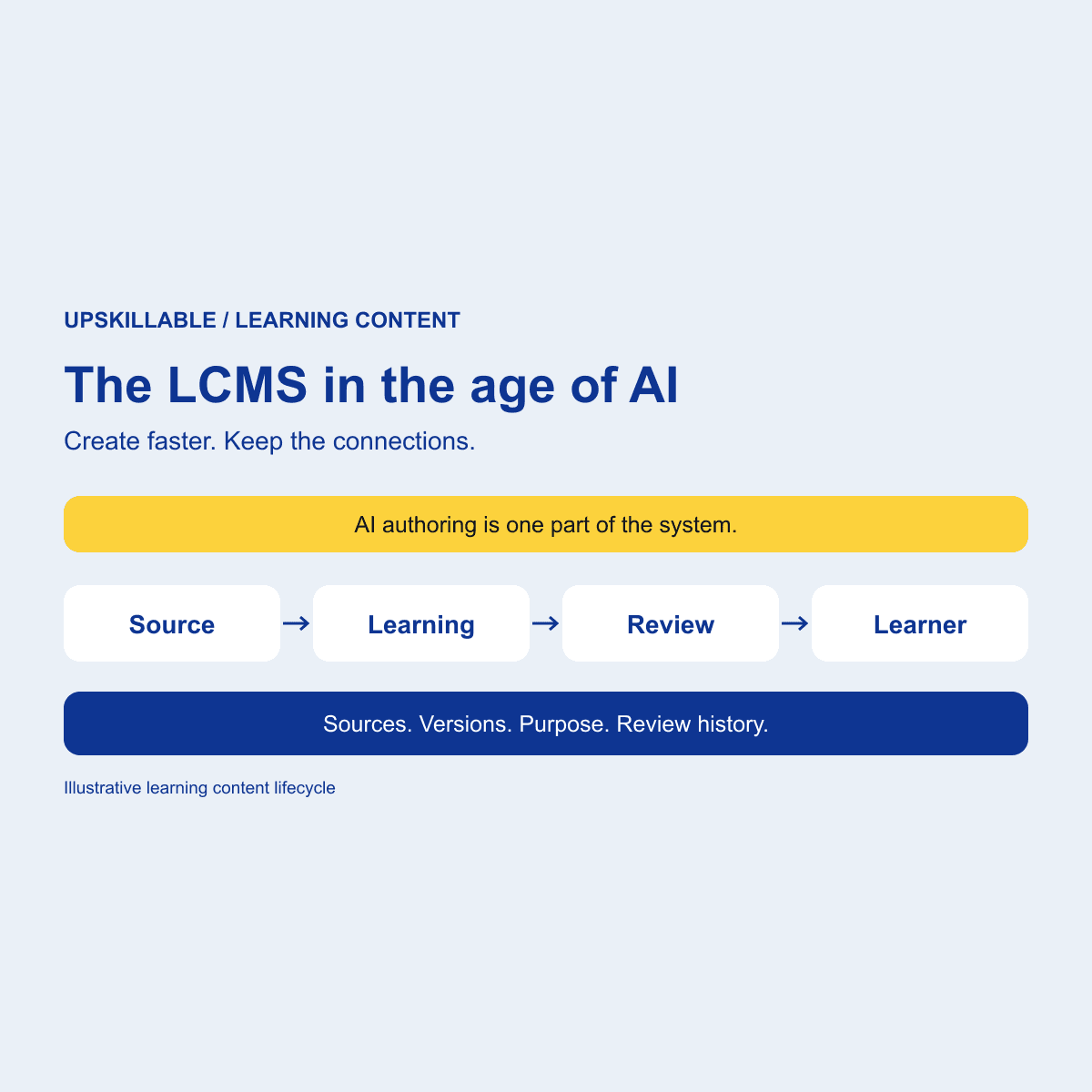
AI Authoring
The LCMS, rebuilt for the age of AI
AI Insights improves what exists. Signals identifies what is missing. See how both connect to AI authoring, learner context, and source lineage.
Romain Gagnon · October 8, 2026