Learning & Development · October 6, 2026
AI-native vs bolt-on LMS
 Romain Gagnon · October 6, 2026 · Founder & CEO
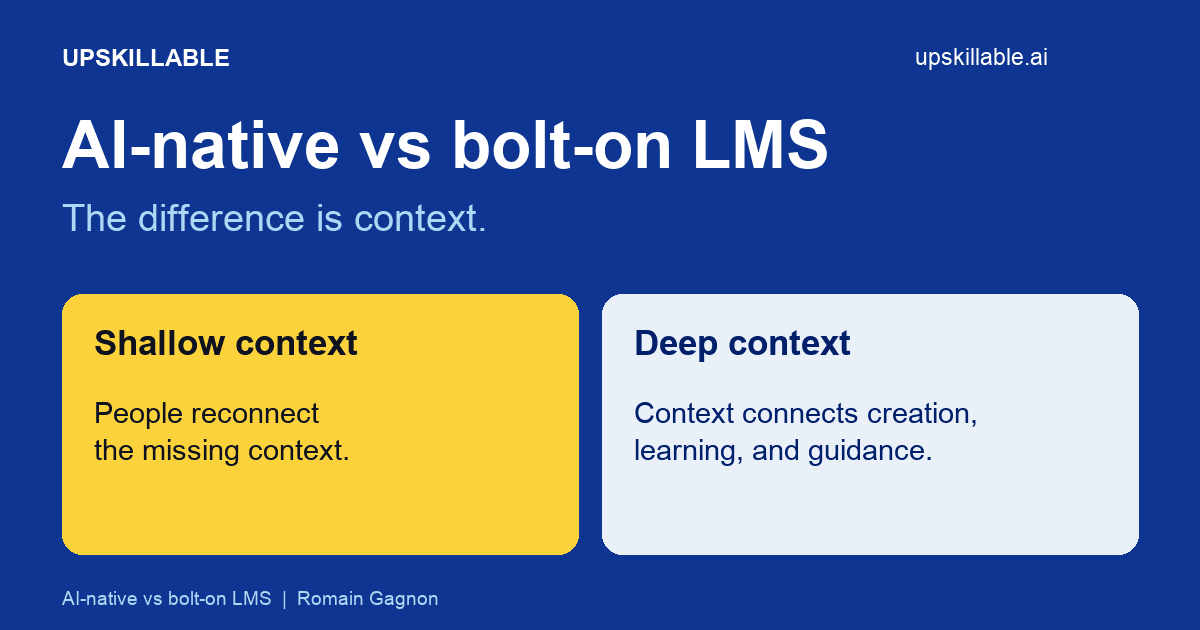
An AI-native LMS should connect content creation, guidance, and the learner’s progress through shared context. Bolt-on AI adds a feature. The difference is how much of the learning experience that feature understands.
Shallow context
- Create
- Package
- Learner
+ AI chat
People reconnect the missing context.
Deep context
- Create
- Learn
- Guide
Shared source · Goal · Learner progress
Learning and feedback stay connected.
What does AI-native actually mean?
For learning, it should mean the context used to create an experience stays available as someone learns, asks questions, and practices. The source gives an answer authority. The goal gives it purpose. The learner’s situation makes it relevant.
That is deeper than answering a question about a document. A useful assistant should understand the lesson someone is in, what they are trying to do, and which earlier practice matters. When they return, they should be able to continue without explaining everything again.
A chatbot beside a course may help. If the learner still has to reconstruct the situation for it, the integration is shallow. Sprinkling AI on top does not connect what is underneath.
Bring one learner into the demo
Imagine a sales team learning a revised product range. The creator uses the approved product guide. A learner then asks which product suits a particular customer.
Does the assistant know which guide informed the lesson? Can it use the customer situation and the learner’s earlier practice? Can the team trace the explanation back to its source?
Ask the vendor to show three things:
- Creation: the source and business goal behind the lesson.
- Learning: guidance that uses the current activity and relevant learner history.
- Continuity: what carries forward when the learner returns or the content changes.
Then ask who reviews changes before learners receive them. More context should make the experience relevant, without giving an agent permission to act beyond its role.
Buy the connection, not the AI badge
LMSs earned their place by delivering training and tracking participation. SCORM supports completion, scores, and interactions. Those records matter. They do not, on their own, connect the creator’s intent to the learner’s next decision.
Upskillable is building the AI-native future of LMS around one connected flow. Our Living Learning System is designed to carry trusted sources and business goals from content creation into learner guidance, practice, and evidence. That shared context gives each interaction a purpose beyond answering the latest question.
Automatic source-change detection and coordinated updates are still in development. The point is to make those connections visible and useful, with people reviewing consequential changes.
Explore product and bring the context test with you.
Sources: ADL’s SCORM guide; checked October 6, 2026. The diagram and sales scenario illustrate our buying criteria, not a customer result.
Related: Why learners leave a course to ask AI · Explore the learner portal and AI Tutor
Connect with us
Tell us what you are trying to get done.
This form reaches the Upskillable team. It is not a public comment thread. Prefer the longer path? Use Get started.
Prefer email? Reach us at hello@upskillable.ai.
Keep reading

Product
Living Courses: built around performance
Learn at your own pace and ask your Tutor for guidance based on your training, right when the work calls for it.
Romain Gagnon · October 11, 2026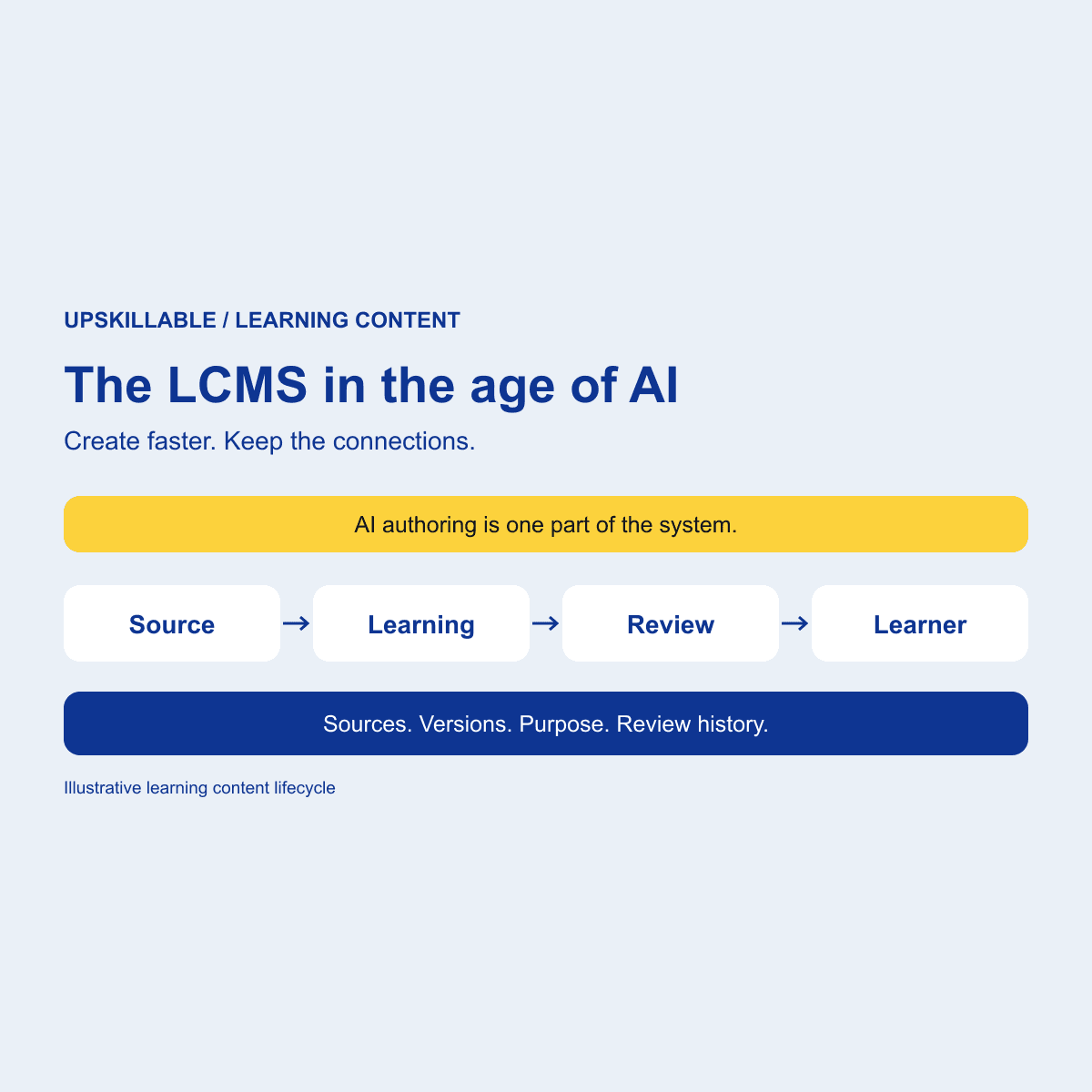
AI Authoring
The LCMS, rebuilt for the age of AI
AI Insights improves what exists. Signals identifies what is missing. See how both connect to AI authoring, learner context, and source lineage.
Romain Gagnon · October 8, 2026