
Learning & Development · August 2, 2026
Fast AI Tools + Old Thinking Means The Wrong Course, Faster.
 Deborah Boccongelle · August 2, 2026 · Chief Revenue Officer
Workplace Learning, Unlearned · Part 1 of 9
Let’s get started.
A senior director asks for a course on Monday morning, to be delivered within a week. It’s something about using a new AI app in a sales workflow. She wants it to be a 30 minute, self-paced learning. You are emailed a few documents with directions and asked to include two recorded screen scenarios with an assessment.
Two years ago that request took four weeks to fill. Four weeks was slow and expensive and everybody hated it. But somewhere at the start of those four weeks, somebody asked that awkward question. What problem is this actually solving?
Today the same course ships by Friday. Nobody asks.
The economics really did collapse
Give the tools their due, because the numbers hold up. AI tools can economically draft, structure, and iterate on training content from unstructured organizational content, from slides to old SCORM files, not just from training outlines and scripts.
The Chapman Alliance benchmark is still the reference point in this field. It puts basic e-learning at roughly $10,054 and 79 production hours per finished hour of output. Adjust for inflation and that is about $14,300 per finished hour today. Current vendor quotes of $15,000 to $25,000 per hour for moderate interactivity land in the same territory.
Against that baseline, here is a conservative like-for-like comparison across three 20-minute artifacts, with human labor counted on both sides: $27,900 down to $5,200, about 81%.
One caveat worth stating up front: the avatar video does most of the heavy lifting in that headline. Strip it out and the same comparison runs $7,900 down to $3,400, a 57% reduction. Still remarkable.
An 81% cost collapse should be the story of the decade in performance development. It is not, because nothing downstream of production moved.
Talent development leaders noticed. In LinkedIn’s 2025 Workplace Learning Report, 49% of learning and talent professionals agreed that their executives worry employees lack the skills to execute business strategy. Half the profession is reporting a confidence problem at the top while production costs fall through the floor.
And this is not a fringe practice anymore. In the 2026 AI in L&D report from Synthesia and Dr. Philippa Hardman, 87% of the 421 L&D professionals surveyed said they use AI, led by voice generation at 63%, content and quiz drafting at 60%, and video creation at 52%. The authors note their sample leans toward early adopters, but with AI generation speeds multiplying and simplified creator experiences, the direction is not in question.
The tools are here. With them are four problems to keep in mind so you make profitable decisions.
Problem one: the one tool is actually five
A typical AI authoring platform runs an LLM for scripting, a slide generator for visuals, a video platform for the avatar, a quiz generator for assessment, and an LMS to deliver the whole thing. Each one has its own login, its own subscription, and its own opinion about what your brand looks like. Much of the stack is pulling from the same frontier models (Anthropic-Claude, OpenAI-GPT, and others) with a markup. Getting the output into your HRIS may also require another tool.
The demo shows one seamless product, yet in reality, your team onboards to five.
So when a course needs one slide to be fixed or an element to be localized (never mind translation), there could be five possible answers.
Problem two: the draft is only 30% of the work
Let’s look at a 20-minute microlearning module. Of roughly 15 hours, about four-and-a-half go into prompting and assembling with AI. The other ten-and-a-half are human: instructional editing, subject matter validation, visual polish, accessibility, QA, and publishing.
Two thirds of the cost lands after the AI stops.
A mixed-methods study in Educational Technology Research and Development found designers reaching for generative AI mainly to brainstorm, draft, and get unstuck. Use was concentrated in the analysis, design, and development phases but rarely for implementation or evaluation. A SWOT analysis in TechTrends reached the parallel conclusion: output looks competent but domain knowledge and instructional design expertise are still what make it reliable.
There’s a big difference between AI design tools and intelligent instructional design. One generates content and the other responds to your learners, delivery context, and subject matter. Designers describe the same failures on repeat. Courses still require a human to direct adaptive learning scenarios. Outputs confidently cite materials that do not exist. Quizzes produce every question as simple recall, which a new hire could answer blindfolded. Scenarios are often set in workplaces your employees have never worked in and written in a voice nobody at your organization has ever used.
Underneath the surface sits the real limitation. These tools organize information well but they do not diagnose a performance gap, choose a method, or design the practice that closes it.
Every one of those failures is caught and repaired by a person. This is not automation. Rather, it is a faster first draft with a longer review cycle attached to it.
Problem three: the meter never stops
The dominant pricing model is a subscription with a fixed AI allowance that then charges per credit, per generated minute, per premium voice, and per extra seat. Regenerating text is cheap but generating media is a whole other story.
Generate an avatar video with five iterations through prompts to get a legal wording or voice change right and you might have paid for traditional video creation twice over. Lip-synced translation usually bills at double credits. Across a sample of eight commonly used authoring and adjacent tools, seven meter AI output in some form. A note of caution: for authoring apps where “no limit” is proposed to generate microlearning or other artifacts, it usually means there’s a soft cap, fair-use ceiling, or throttling after some threshold in the contract.
Here are common hidden charges of AI content authoring tools:
- Additional author, collaborator, or editor seats
- Extra AI credit packs, or a forced jump to a higher tier
- Video regeneration and translation minutes
- Premium avatars, voices, models
- Higher-resolution rendering
- Custom avatars and voice cloning
- AI dubbing, lip-syncing, and multilingual versions
- API generation and automation volume
Do not expect the underlying model economics to rescue you either, because that story has two sides.
Prices for economy and mid-tier models are genuinely collapsing. A systematic analysis of the LLM inference market documents roughly a 600-fold decline in the cheapest available token price since 2020, with economy-tier prices halving every 1.1 years and mid-tier every 1.5 years. Both are outrunning Moore’s Law. But flagship frontier AI models using extended-thinking tokens behind the scenes (step-by-step problem reasoning) have barely moved. This reasoning carries a premium multiplier 6 to 28 times the non-reasoning rate.
What does this mean? For those of you holding a budget, the list price is an unreliable guide to the invoice. In a systematic study of eight frontier reasoning models, the model with the cheaper listed price turned out more expensive in about a third of head-to-head comparisons, sometimes by 28 times, because thinking token consumption varies so wildly. On an identical query, one model can burn 900% more thinking tokens than another. Run the same query twice on the same model and consumption can vary by a factor of 9.7. Stack agentic (autonomous) workflows on top and the forecasting problem compounds.
In the end, your per-token price will probably fall. Your bill will probably rise, because usage grows with reasoning, agents, re-renders, and translation, and because actual consumption is genuinely hard to predict. Budget for usage growth and variance, not for token inflation.
The pitch was that editing is free now. The invoice disagrees.
Problem four: the output never meets the learner
Bolt an AI chatbot and an authoring tool onto a traditional LMS and you accelerate drafting, quizzes, and media. Then the whole thing hands off to a delivery world it knows nothing about, and the disconnections compound. This is especially true for self-created AI authoring tools built directly in Claude design, GPT, and others. Token credits are burned at an alarming rate to create a non-reusable and potentially unsafe workflow.
Without retrieval-augmented generation, usually shortened to RAG, the AI assistant answers from its general training data instead of your approved organizational content, and it does so with complete confidence. RAG is worth knowing by name if you sit in HR or L&D leadership, because it is the difference between an assistant grounded in your policies and one improvising around them.
Without traceability, a learner cannot see where an answer came from, so the question of whether to trust it has no evidence behind it. Without integrated editing, hosting, and delivery, every artifact gets exported, transferred, republished, and separately maintained across systems, which is exactly where content goes stale.
With RAG, answers are grounded in your own material, and Model Context Protocol (MCP) gives AI applications a standard way to connect to other data and tools. Double check how an authoring tool (inside or outside the LMS) automatically delivers citations, governance, or instructional quality with learning artifacts. We explore this topic later in this series.
If an LMS says it’s AI-first or AI-assisted, ask about its depth in RAG or MCP. A brilliant draft disconnected from the learner’s actual experience is just a draft. It is not contextual learning. AI authoring should offer traceability or everything goes stale the moment it’s produced.
The tools are not the reason
Every tool above is executing a decision that was made before anyone opened it. That is why cheaper production has not moved capability, and it is where the real problem lives.
First, some empathy for the people making those decisions. Budget pressure, restructuring, and role consolidation have thinned already-lean L&D functions, and industry workforce data shows unusually high numbers of L&D professionals listed as “open to work.” Meanwhile skills change faster and demand for upskilling keeps climbing. Teams are asked to cover more employees, more priorities, and more formats, often while babysitting legacy systems, with a quiet expectation that AI will absorb the difference.
When there is no capacity for diagnosis, prescription wins by default. The four reflexes below are not laziness. They are what a thin team does under a deadline and that is exactly why they are worth naming.
- Prescription before diagnosis. The senior director from the top of this article gets the course. Designers are in execution mode with a long queue behind them. With AI, the wrong course in the wrong format now ships in five days instead of four weeks, and joins the catalog graveyard in the LMS a little sooner.
- The document becomes the design. An 80-page policy PDF goes in. A 20-slide summary comes out, now with an avatar reading it aloud. The SME’s favorite research becomes the curriculum. The capability gap and the question of skill transfer never enter the room.
- Completion theatre. The rollout hits 98% and leadership celebrates, yet the error rate it was built to fix does not move. Quiz scores measure short-term recall but not performance of work, and the LMS cannot tell the difference.
- Ship and freeze. The product team releases v2 on Tuesday. The course still teaches v1 to the fall onboarding cohort, because updating it means re-entering the whole pipeline and, under metered pricing, reopening the wallet.
None of these is a tool failure. All of them are design behavior, and speed makes every one of them worse, because the gap between a bad decision and a published artifact used to be long enough for somebody to raise a hand. Now it is not.
Fast tools, old thinking
The worst part is that most organizations cannot see the waste. Fewer than 30% measure whether learning gets applied on the job, which means the majority are tracking what was completed rather than what was used. Cheaper production does not close that gap. It industrializes it. The waste gets faster to make, easier to approve, and stays just as invisible.
This is why another point solution may not help, and neither will squeezing another 25% out of the learning technology stack you already have. AI applied to an unchanged workflow produces the old failure at new speed. Designers who change their practice without AI in the foundation cannot scale the change. Both have to move together: infrastructure that connects design to diagnosed gaps, real sources, and learner signals, and design practice that starts from the gap instead of the deliverable.
So before the next build, come back to these four questions:
Why does this course exist before anyone diagnosed a gap?
Why is a document upload defining the curriculum?
Why are we accepting completion data as evidence?
Why will this content sit still while the business moves?
Good answers to those four, and you should build, with every tool you can get. Bad answers, and no tool on the market can save what you are about to make.
Tell us where it hurts
Use the form below and tell us where your team feels this most, whether that is creation, cost, or proof of impact. Follow us on LinkedIn so Part 2 lands in your inbox instead of your feed. We will be exploring course-authoring options for different needs.
Workplace Learning, Unlearned. Part 1 of 9, from the team at Upskillable.
Connect with us
Tell us what you are trying to get done.
This form reaches the Upskillable team. It is not a public comment thread. Prefer the longer path? Use Get started.
Prefer email? Reach us at hello@upskillable.ai.
Keep reading

Product
Living Courses: built around performance
Learn at your own pace and ask your Tutor for guidance based on your training, right when the work calls for it.
 Romain Gagnon · October 11, 2026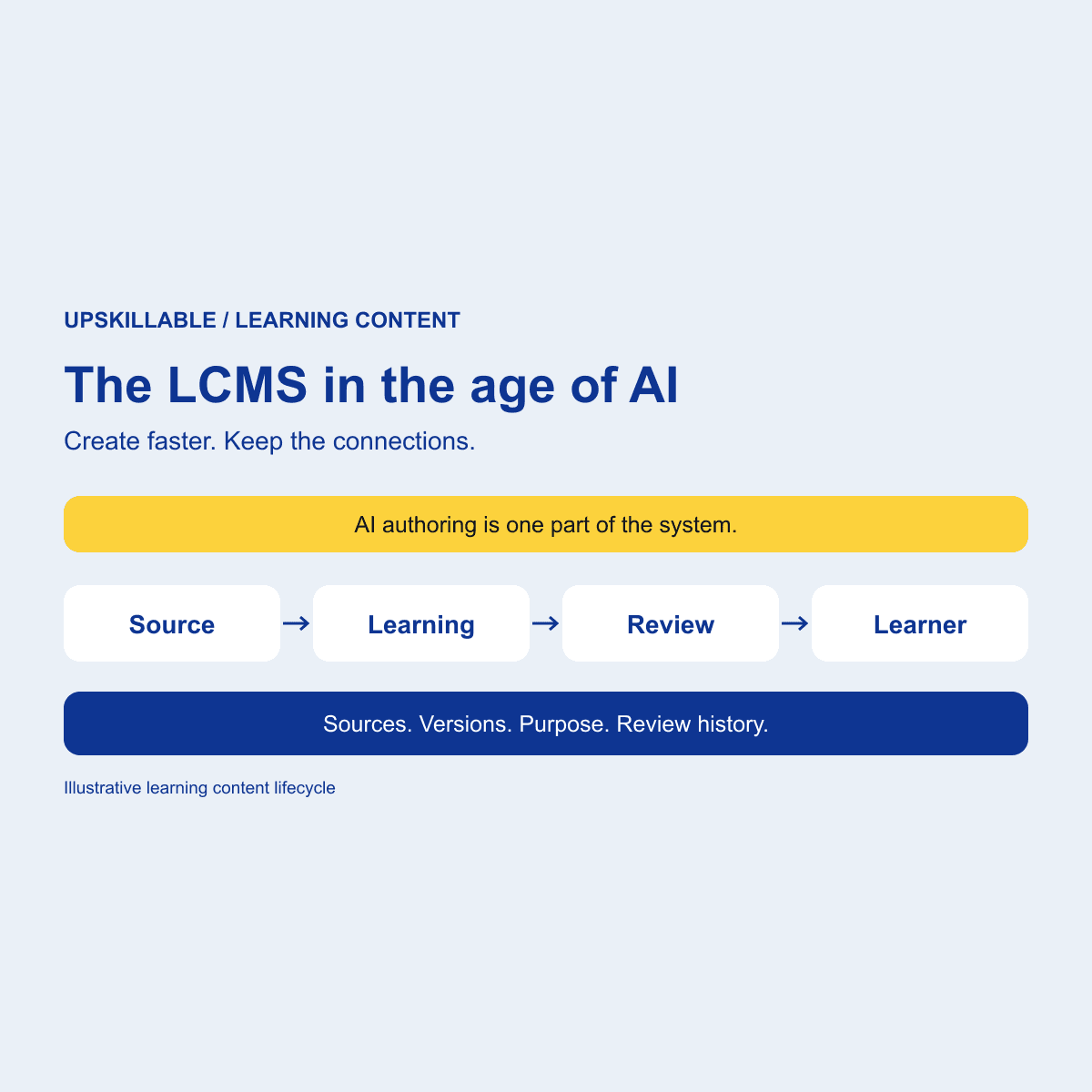
AI Authoring
The LCMS, rebuilt for the age of AI
AI Insights improves what exists. Signals identifies what is missing. See how both connect to AI authoring, learner context, and source lineage.
Romain Gagnon · October 8, 2026